

New Orleans to be nation's 'microgrid capital' through Neighborhood Power Plan, backers say
As the New Orleans City Council prepares to take up a program to install backup batteries in hundreds of homes, businesses and community institutions, advocates of the initiative gathered Wednesday outside City Hall to emphasize the importance of the plan in a city that has been plagued in recent years by grid failures.
Dubbed the “Neighborhood Power Plan," the $30 million program is set to create the nation’s largest virtual power plant, per capita, with a vastly expanded network of batteries in individual homes and business that kick on when the lights go out or the grid is strained.
“When we talk about reliable power, we are really talking about public health infrastructure,” said Jeanie Donovan, public health and policy director for the New Orleans Health Department.
During a power outage, homes get dangerously hot, communication is disrupted, food goes bad and medication can’t be refrigerated. According to Donovan, the deaths of 29 people in the wake of Hurricane Ida in 2021 were associated with power outages or generators across Louisiana.
“The Neighborhood Power Plan takes the lessons of Ida and other storms and turns them into action, putting solar-connected battery systems on homes and community institutions so vulnerable residents and critical infrastructure can have another layer of protection when the grid is disrupted,” Donovan said.
The plan has been in the works for more than a year and will be funded with proceeds from a settlement between the city and Entergy New Orleans over allegations of mismanagement of the Grand Gulf nuclear plant. Later this month, the City Council will begin finalizing rules for the program.
The city’s current target for the program is to provide batteries to about 800 homes and 220 businesses or other institutions, with 40% of funds reserved for low- and moderate-income households.
It's not clear how much homeowners will have to pay for battery installation or whether they will need to already have solar panels on their roofs.
Nathalie Jordi, a leader with the community organizer Together New Orleans, said advocates are pushing the council to make battery installation free for low-income ratepayers, while charging others around $5,000, to be paid over time. She favors limiting batteries to place that already have solar panels, though it’s ultimately the council’s call.
“I think as a resilience asset, they have a lot less value if they’re not tied to solar,” she said.
Maximizing the microgrid
The Neighborhood Power Plan grew out of the broader Community Lighthouse Program, an initiative created by Together New Orleans after the widespread grid failures following Ida. That program seeks to create resilience hubs by installing commercial-scale solar panels and backup batteries on churches and community centers.
“We were like, ‘We should have a lot more of these on homes, on businesses, on wherever. Put a battery everywhere,’” Jordi said Wednesday.
Separately, the city recently finalized billing rules for its community solar program, which allows residents without solar panels to reduce their electricity bills by subscribing to solar farms.
Together, the two programs are the first steps in a broader effort to create a microgrid — a network of batteries powered by solar panels, linked together so that Entergy can draw on them directly when the larger grid is stressed.
Currently, there are about 15 community lighthouses and 120 homes tied into the local microgrid.
Garreth Johnson, a leader at Together New Orleans and the head of the community lighthouse at Cornerstone United Methodist Church in New Orleans East, said microgrids solve both of the biggest problems facing the grid.
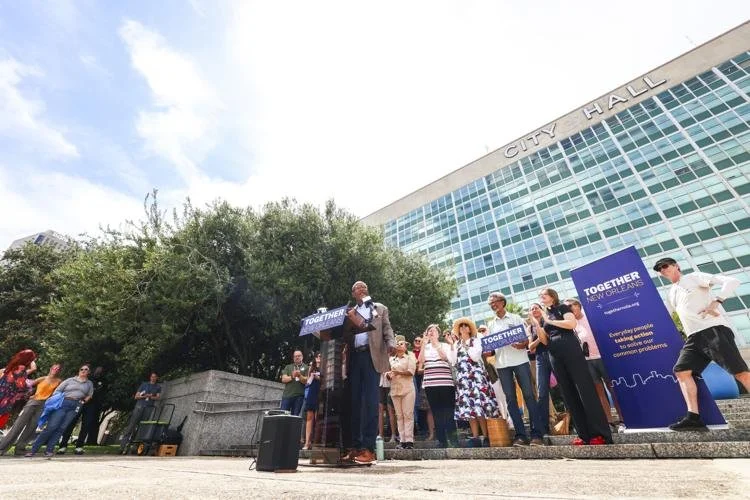
Garreth Johnson leads a Together New Orleans Neighborhood Power Plan Press Conference on the steps of City Hall in New Orleans, Wednesday, Sept. 9, 2026. (Staff photo by Sophia Germer, The Times-Picayune)
“Microgrids solve disruption by providing backup power that can stay on when the grid goes down, and they help solve congestion, because those batteries can send locally stored power back onto the grid when electricity is scarce and expensive,” Johnson said. “What the neighborhood power plan would do, in a single sentence, is to make New Orleans the microgrid capital of the country.”
District A Council member Aimee McCarron, who chairs the council's Climate Change and Sustainability Committee, said the city must avoid relying too much on large, centralized infrastructure in light of shoddy reliability and repeated failures.
“Having energy resources throughout our neighborhood gives us another layer of protection when parts of the larger system fail and makes our local power supply more reliable to build a stronger and more resilient New Orleans,” McCarron said.
