

The Spark: The ‘Community Lighthouses’ Where Neighbors Help Neighbors
Neighbors light the way
As Hurricane Francine plunged New Orleans into yet another extended blackout in 2024, Pastor Shawn Anglim opened up the First Grace United Methodist Church and turned on the lights. “By the afternoon it was packed,” he says. “More than 100 people in air conditioning, charging up medical devices, charging up their phones.”
Anglim’s church is one of a growing network of Community Lighthouses — churches, synagogues, mosques and community centers in Louisiana that have set up solar panels and batteries to provide their communities with electricity in times of need.
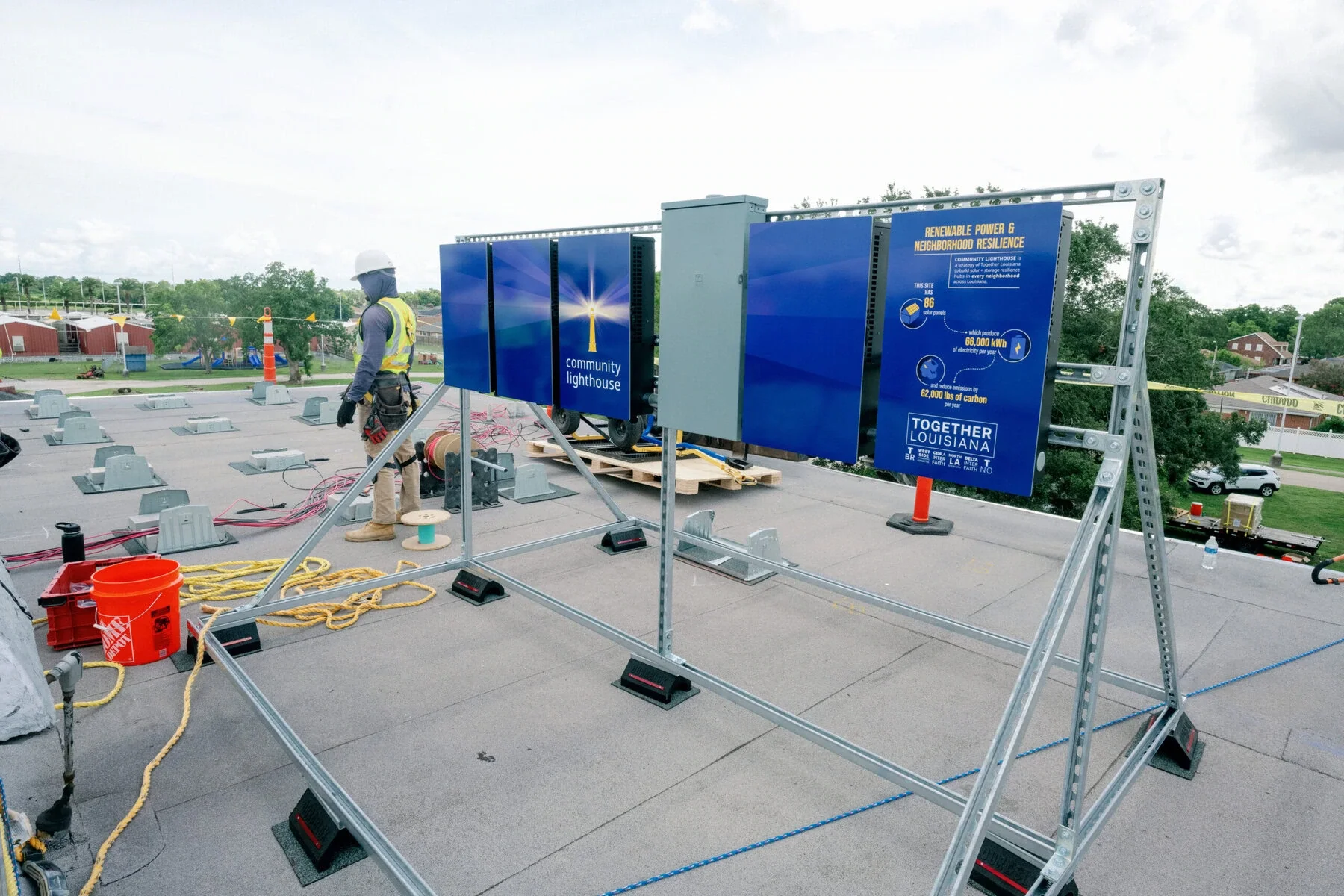
There are now 14 Community Lighthouses in New Orleans and an additional six in broader Louisiana. Courtesy of Together New Orleans
The idea was born in 2021, after Hurricane Ida caused the most extensive power outage in Louisiana’s history, leaving parts of New Orleans with no power for 12 days. The storm was followed by a heatwave, leading to at least 11 heat-related deaths as people were unable to use air conditioning in their homes.
“That really gave us all pause, you know, what can we do about that?” says Anglim. Blackouts coinciding with heatwaves are expected to increase dramatically in the coming decades due to climate change, and Louisiana already has the highest number of power interruptions and the longest-lasting blackouts in the U.S.
Anglim and other local faith and community leaders were discussing better ways to serve their communities on a Zoom call when the idea of solar microgrids came up. “I was like, this is the most far-fetched idea I could ever imagine. But lo and behold, we put a proposal together. We went to [the philanthropic institution] Greater New Orleans Foundation and asked them for $1 million, and they gave it to us,” says Anglim.
After securing initial funding, the project was launched in 2022 by Together New Orleans, an organization of congregations, unions, neighborhood associations and civic institutions, and its parent organization Together Louisiana. There are now 14 Community Lighthouses in New Orleans, and an additional six in broader Louisiana, with the goal of eventually establishing 66 more.
“The Lighthouses also provide power backup during more routine neighborhood outages,” says Liana Heath of Together New Orleans. “[They] are designed to serve both as emergency hubs during major disasters and as a source of resilience during the more frequent outages communities experience throughout the year.” Once their batteries are full, the Lighthouses let their excess electricity flow into the grid, providing an additional layer of energy resilience for the city, which imports almost all of its electricity via a handful of transmission lines, making it especially vulnerable to disruption.
By keeping the lights on, Lighthouses also become the natural point for other services to converge, says Anglim. In the aftermath of Francine, the Salvation Army and a local food bank brought food to his church, the city set out oxygen tanks and a local NGO began distributing portable solar generators. “All these people could do something because we had power,” says Anglim. “It all sounds organic, but it’s only organic because there was a Community Lighthouse.”
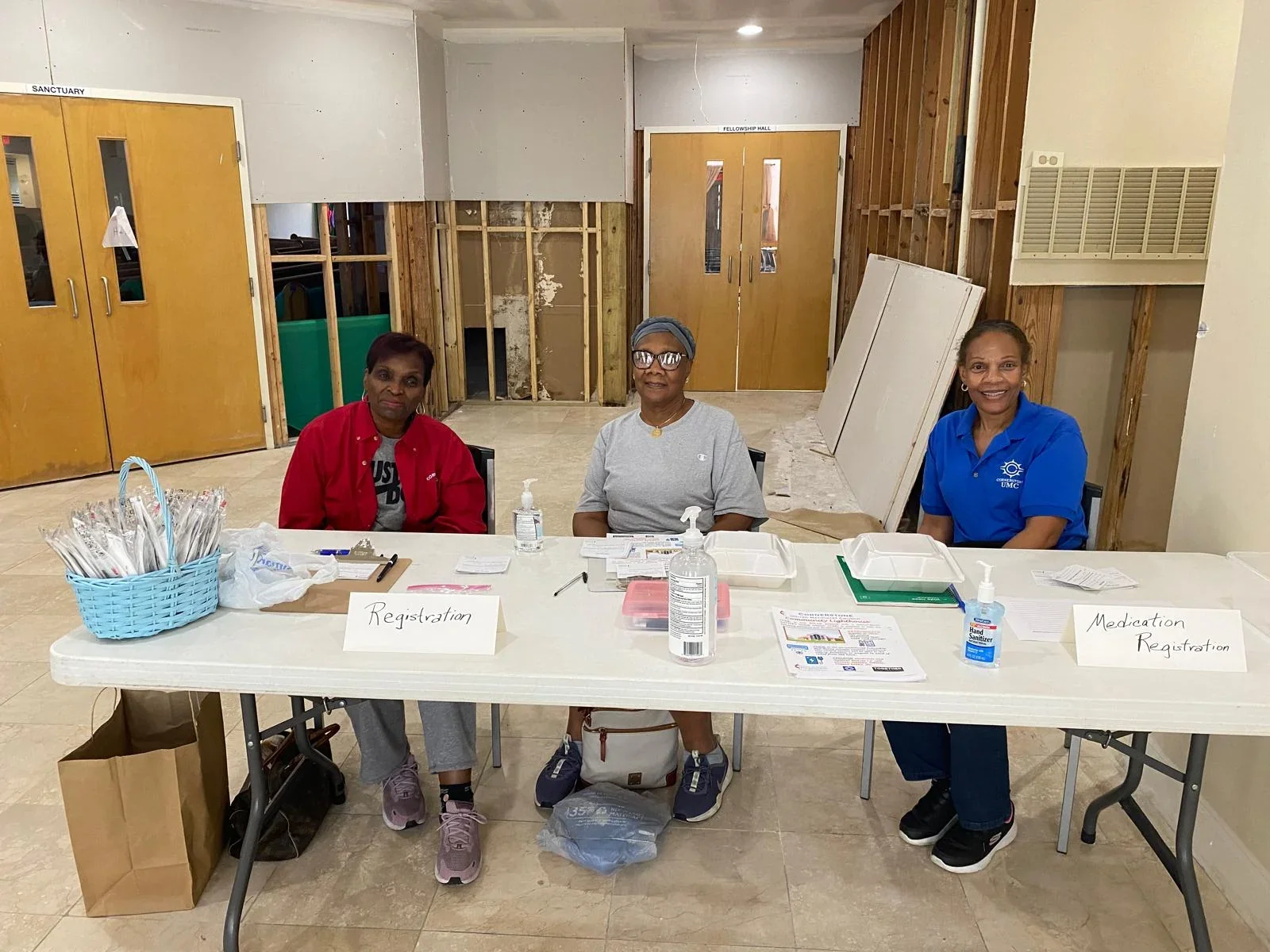
Volunteers at a Community Lighthouse. Courtesy of Together New Orleans
Ensuring smooth operations in a disaster scenario takes forward planning. Who will decide when to open the Lighthouse? Who will actually open the door, set out the equipment, make sure there’s water, keep an eye on the battery backup system? Volunteer “lighthouse keepers” take the lead and delegate specific tasks to other volunteers in the community, so that everyone knows their role when it’s go time. “We just did a test run about three weeks ago,” says Anglim. “But there’s good planning and then there’s reality.” People might need to go to work, or evacuate in the case of a bigger storm. But, Anglim says, other volunteers tend to show up to fill in the gaps.
There has been a lot of interest in the Community Lighthouse model from across the U.S., and the Metropolitan Organization in Houston, Texas, recently secured funding to open the city’s first Community Lighthouse.
While financing such an endeavor is an important first step — Community Lighthouses in New Orleans are now funded through a mix of public-private partnerships and philanthropic donations — finding community partners from diverse backgrounds is key to ensuring longevity, says Anglim.
“Community Lighthouse came out of the idea that we need to be a better community,” he says. “We don’t want to just call the city and complain about what they’re not doing. We need to have skin in the game. This is our community too.”
Learn more about Community Lighthouses here.
DIY mesh networks
Anyone who’s been to a LAN party will be familiar with the basic idea — connect a couple of computers with cables, and you’ve set up your very own network in your living room.
Now take it a step further — connect a couple of wireless routers, and you’ve got the beginnings of a communally owned mesh network that could span a city block or even an entire region, closing the digital divide by bringing affordable network access to areas where public service is sparse. As each router becomes a node in the system, the system also offers a decentralized and community-run alternative to those wary of relying on a single private provider.
The biggest community network was started in 2004 in Spain, when neighbors in a rural Catalan municipality some 70 kilometers north of Barcelona banded together to improve internet access in a region deemed unprofitable by private providers. The project, known as Guifi.net, has since grown into a foundation that is also building physical infrastructure in collaboration with local authorities, connecting over 100,000 rural Catalans.
A neighborhood emergency service
In medical emergencies, every minute matters. But for many communities, ambulances arrive late, if at all.
Hout Bay Volunteer Emergency Service in Cape Town was started in 1994 by a group of residents concerned about delays in ambulance responses. Despite being close to the city’s emergency medical facilities as the crow flies, Hout Bay is difficult to reach because it is surrounded by mountains on three sides and the coastline on the fourth, and only accessible via three mountain roads.

Chapmans Peak Drive is just one of three roads into Hout Bay. Credit: Martinvl, CC
Initially, the volunteers responded to calls with their private vehicles, eventually receiving an ambulance on loan from the provincial emergency services and finally purchasing their own community-sponsored ambulance. Now, the service has around 40 volunteers working on weekends and public holidays in close collaboration with the local government’s emergency services.
A 2022 study found that Hout Bay Volunteer EMS responded in their own area 42.3 percent faster than the local government’s EMS, consistently beating the target response time of 15 minutes.
While there are a number of other volunteer emergency services in Cape Town and across the African continent, the success of Hout Bay’s service shows that community-led emergency services can become a sustainable long-term solution.
