

Volunteers to expand disaster resilience hubs across Louisiana: ‘Power makes the difference’
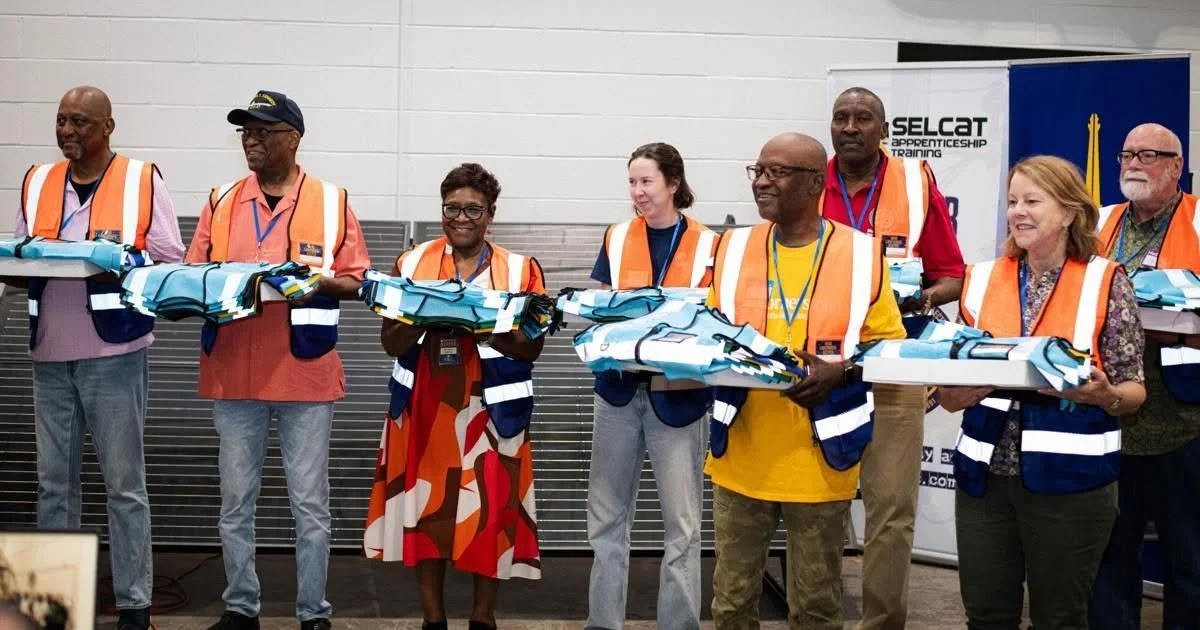
Community Lighthouse volunteers hold a vest ceremony at the group’s annual gathering on May 30, 2026.
When 90 mile per hour winds pummeled Baton Rouge in 2008 during Hurricane Gustav, Rev. Thomas Clark of Immaculate Conception Church in Scotlandville said the congregation felt “paralyzed.”
The church had planned to assist people throughout the city, but a widespread electricity outage hindered their ability to lend a helping hand. But after the floods that swept the area in 2016, the church was able to step up to provide food and other support to those affected.
The difference? The church maintained power in 2016.
“Power makes a difference,” Clark said at the second annual gathering of Community Lighthouse keepers.
Community Lighthouse are buildings with a solar power and battery system that provides power when electricity is down, creating a place for people to charge their devices and for electrical workers to rest while fixing the outage. About 95 community and faith leaders gathered at the International Brotherhood of Electrical Workers Training Facility Saturday for an annual training on preparing and running Community Lighthouses, focused on taking the model that is growing throughout the state and ensuring its sustainability for the future.
The IBEW site was unveiled as Baton Rouge’s first Community Lighthouse in February, joining about 18 other resilience hubs in the state. Lighthouses in northern Louisiana activated during Winter Storm Fern in late January, which coated the region in ice leading to several deaths, power outages and a disruption of daily life.
“This year, we’re starting something that’s resilient,” Jason Dedon, business manager of IBEW No. 995, said at the training.
Together Louisiana, a group of 250 congregations and civic organizations, is spearheading the project, with a goal to have a lighthouse within 20 minutes of every resident. Installation of Baton Rouge’s second Community Lighthouse began at Immaculate Conception last week.
The day-long training led volunteers through identifying members of their congregation or organization for specific roles in the lighthouse, such as head lighthouse keeper, medical lead and kid zone captain.
Dedon said the first annual lighthouse keepers’ gathering focused on how the organizers could help people during disasters, but this year’s is moving that action forward and figuring out how to keep the lighthouse hubs sustainable. The Baton Rouge lighthouse has been activated four times since its kickoff in February due to minor electricity outage events, which Dedon said has brought a new challenge for organizers to figure out how the lighthouse can help the community in “blue sky” issues, or outages that occur when there is not a storm.
Local lighthouse keepers will raise awareness that the disaster resiliency resource exists through partnering with other local organizations and door-to-door marketing.
“As we build new lighthouses, it becomes tangible,” Dedon said.
A few volunteers from Texas attended the meeting to learn more about the commitment it takes to establish and run a Community Lighthouse. Terry Grim of Bay Area Unitarian Universalist Church in Houston said her congregation is very involved in social justice work, so a resilience hub would fit into their volunteerism.
A working partnership with a mosque nearby will also aid their lighthouse to bring in more resources and awareness of the hub, she said.
“There’s a big interfaith effort,” Grim said.
The lighthouses aim to shift power use toward renewable sources and away from natural gas and coal, an energy report included in materials for the training states. This year to date, the lighthouses have produced more than 278,000 kilowatt hours of energy — enough to provide power to 27 homes for a year.
“We hope that before the day is over, you'll see something that reminds you that a lighthouse exists because storms come,” Rev. Theron Jackson, senior pastor at Morning Star Baptist Church of Shreveport, said. “A lighthouse exists because ships get lost. A lighthouse exists because people need direction, and a lighthouse exists because communities need refuge."
