

Council set to green light $30 million power resiliency plan
Using money from an Entergy settlement, the plan aims to strengthen the power grid by funding battery systems across the city.
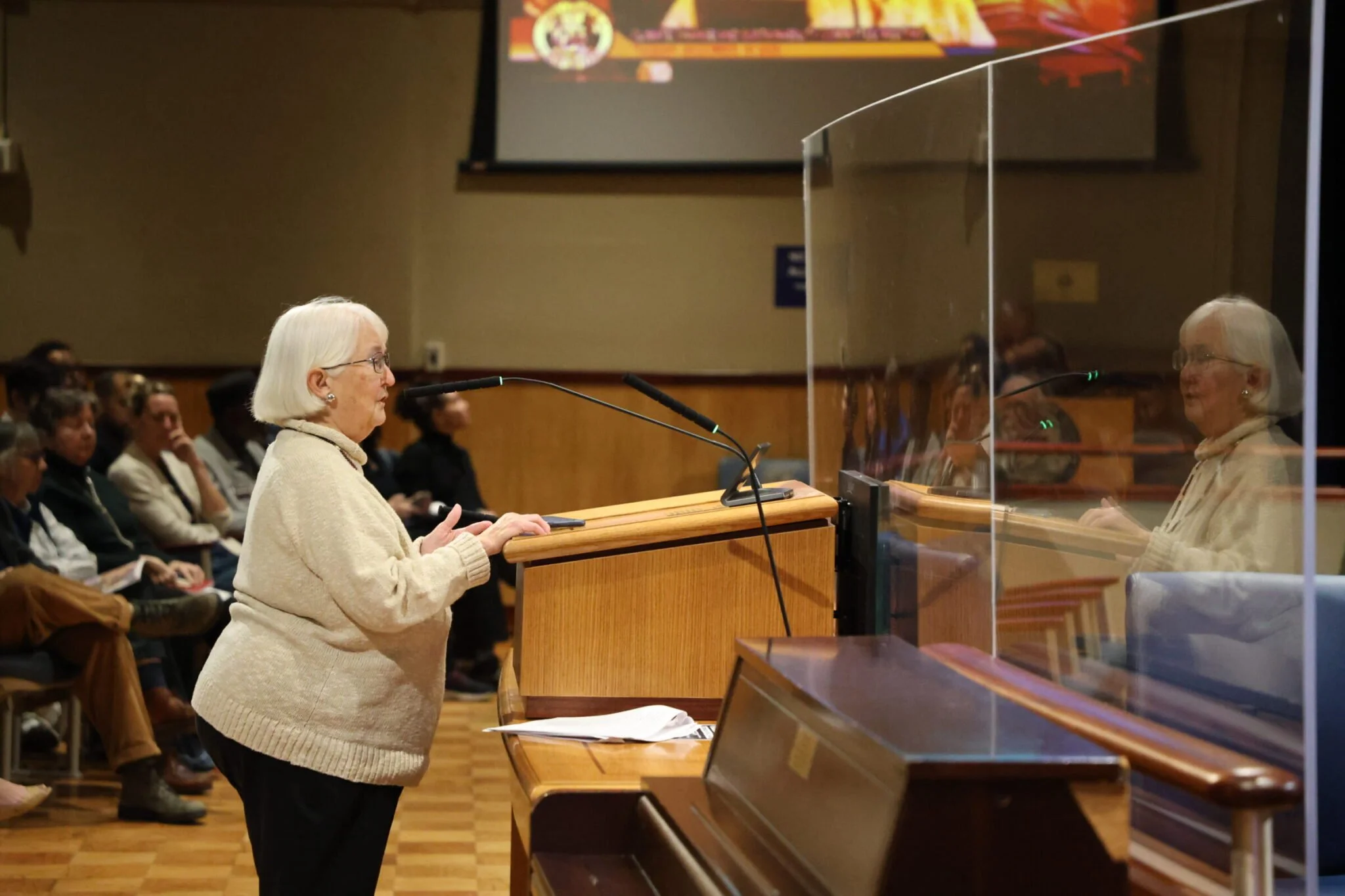
Becky Meriwether voiced her concerns about power grid resiliency at a New Orleans City Council committee meeting on Tuesday, Dec. 16, 2025. Credit: Aliana Mediratta / Verite News
New Orleans is poised to move towards a more sustainable power grid following a Tuesday (Dec. 16) meeting where City Councilmembers spoke positively about a plan that would use $30 million over three years to create a “virtual power grid” of batteries in order to reduce the strain on the power grid and provide power during outages.
“What we’re doing today is really transformative,” said Erin Spears, Chief of Staff for the Council Utilities Regulatory Office. “It is the largest single investment and community-led sustainability [effort] ever made in New Orleans and right now, we’re saying that this is also the largest project like this per capita in the country.”
The measure was heard by the council’s Climate Change and Sustainability Committee, where Councilmembers Helena Moreno, JP Morrell and Lesli Harris voiced support. The resolution will be considered for final approval at Thursday’s regular council meeting on Dec. 18.
If approved, the money will go to funding battery systems for approximately 1,500 residences and 300 businesses or community buildings, including churches and nonprofits.
The funding for the program comes directly from a $116 million settlement finalized last year, between the city and Entergy over longstanding reliability issues with the utility’s Grand Gulf Nuclear Station in Mississippi, meaning the program will not affect the city’s budget or increase costs for ratepayers in New Orleans.
Spears explained during the meeting that this will allow for a backup power source during outages and create reserves of energy that can be relied on during peak usage times, reducing demand on the grid.
Energy resilience has long been a pressing topic for New Orleans. Together New Orleans, an advocacy group composed of local community and faith organizations, has been pushing for increased power grid resiliency since Hurricane Ida, which led to an extended power outage after the transmission lines bringing electricity into New Orleans were knocked out. According to the New Orleans Coroner’s Office, excessive heat after the storm caused or contributed to 19 deaths in the city.
Nearly 100 people, including members of Together New Orleans, turned out to the committee meeting on Tuesday to detail the lengthy process that led to the initiative being created.
Desha Greeley, who lives in New Orleans East, spoke about the immediate impact that a battery system would have for residents like her who have solar panels that become functionally useless when the power goes out. Only solar panels that have an independent battery storage system continue to work during outages.
“The sun is shining, but without a battery, they cannot power my home,” Greeley said. “About 10,000 homes in the city already have solar panels, but only a few hundred have batteries. That means most of the potential is going to waste when we need it the most.”
Becky Meriwether, who lives Uptown with her husband, told the committee that she had concerns about her husband’s ability to survive during an outage due to health problems including congestive heart failure and cancer. Through the process of installing solar panels on their house, she grew concerned about the stability of the power grid.
“I really worry about his survival in those situations,” she said. “This [initiative] is a huge step forward towards helping people who are vulnerable sustain life and live well in our environment.”
By providing incentives for residents to install solar panels in homes and businesses across the city, the plan aims to strengthen the power grid and create a virtual power plant that can provide support both during peak demand and outages. The program will offer rebates after solar panels are installed, with 40% of the funding being reserved for low-income households.
“These [virtual power plan] programs exist all over the country now, increasingly because they’re good for the grid, but in New Orleans, we have this additional layer of life saving, because we have these life threatening power outages,” Nathalie Jordi, a real estate developer who works with Together New Orleans, told Verite News.
The battery system, Jordi explained, provides two layers of benefit — it offers a backup in case of outages and it keeps the power grid sturdier when weather conditions are good.
Under the virtual power plan, power would be distributed across a “micro grid,” a localized power source pulling from thousands of devices rather than connecting homes to a far away consolidated power plant. During normal weather, energy from the batteries can flow to the power grid, and during outages the battery’s energy will be directed to power the building it’s attached to.
“The farther electricity has to travel, the easier it is to lose it and micro grids abolish that distance,” Jordi said. “We’re building outlets closer to where we actually need the juice, and that will save lives. What’s amazing about batteries is that they’re useful not just during outages, they serve on blue sky days too.”
In the wake of Ida, Together New Orleans launched an initiative to help equip community centers — called “lighthouses” — with the power capacity to host local residents during outages. With 18 lighthouses posted throughout the city, including churches Uptown, Mid-City, and in New Orleans East, and a plan to create 85 total, the program aims to put all New Orleans residents within a 15-minute walk of a location equipped with emergency power.
Together New Orleans hopes to see the virtual grid program build upon initiatives, including the community lighthouses, to prepare for outages ahead of time, rather than creating infrastructure that only has the capacity to respond to crises after they occur.
Residents can expect to see a three-year implementation plan filed by March 1, 2026, detailing the program design and targets it hopes to achieve.
Aimee McCarron, District A Councilmember-elect, attended the meeting to affirm her commitment to push for grid resilience in the future. McCarron, along with other new councilmembers, will be sworn in to office in January.
“It is transformative and it’s important to our community,” McCarron said, “and as incoming chair of the Climate Committee, I look forward to continuing to innovate and drive change in the years to come.”
