

Times-Picayune: City advances 'transformative' $28M battery initiative to cut outages and power bills
The City Council’s committee vote clears the way for hundreds of subsidized batteries at homes, businesses and community sites, using settlement funds to bolster reliability and lower costs.
BY ANTHONY MCAULEY | Staff writer
The New Orleans City Council on Tuesday advanced a plan to spend $28 million from an Entergy overcharge settlement on hundreds of battery installations across the city, moving forward what supporters describe as a transformative effort to keep the lights on for homes, businesses and community centers during storms, heat waves and other grid failures.
The initiative cleared the council’s Utilities, Cable, Telecommunications and Technology Committee with support from all seven City Council members. A final vote by the full City Council is scheduled for Thursday, where it is expected to pass without opposition.
Mayor-elect Helena Moreno, who chairs the committee and has led work on the initiative, said the measure would launch New Orleans’ first large-scale Distributed Energy Resource, or DER, program — using batteries installed at homes, apartment buildings, businesses and community institutions both to provide backup power during outages and to strengthen the grid during periods of peak demand.
Mayor-elect Helena Moreno, who chairs the City Council's Climate Change and Sustainability Committee, hears from supports of the new $28 million "micro grid" initiative on Tuesday, Dec. 16, 2025. The plan, funded by an Entergy overcharge settlement, will deploy batteries to help homes and businesses keep the lights on during Entergy outages and help bring down bills.
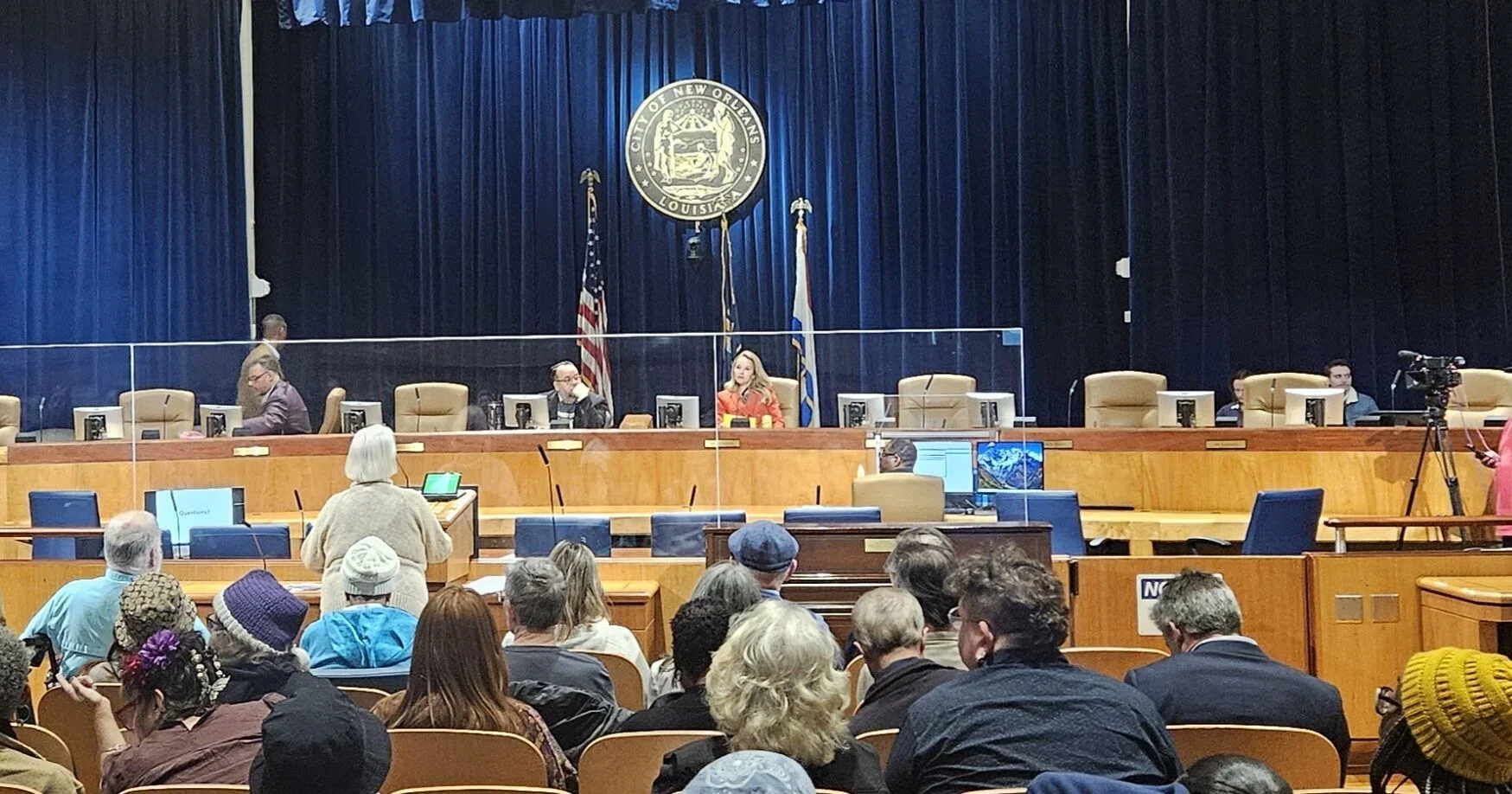
Mayor-elect Helena Moreno, who chairs the City Council's Climate Change and Sustainability Committee, hears from supports of the new $28 million "micro grid" initiative on Tuesday, Dec. 16, 2025. The plan, funded by an Entergy overcharge settlement, will deploy batteries to help homes and businesses keep the lights on during Entergy outages and help bring down bills. Anthony McAuley
More than 100 supporters packed the council chamber Tuesday, including church leaders, business owners and community organizers who framed the initiative as a necessary response to repeated large-scale outages since Hurricane Ida and an increasingly fragile electric system.
“This is transformative,” Moreno said in her statement to the chamber Tuesday, calling the initiative the largest single investment in community-led sustainability the city has ever made and one of the largest projects of its kind on a per-capita basis nationally.
Settlement funds citywide batteries
The $28 million allocation comes from a broader $116 million settlement reached last year between Entergy New Orleans and the City Council, which regulates the utility, resolving federal investigations into whether customers were overcharged for power from the Grand Gulf nuclear plant.
While most of the settlement will be returned to ratepayers over time, the council retained discretion over a smaller portion of the funds. That pool was reduced earlier this year after some money was used to offset a rate increase, leaving $28 million now slated for the battery program.
Under the plan approved Tuesday, incentives would help pay for battery installations at participating properties across the city. During outages, those batteries would provide a backup source of electricity for essentials such as lighting, refrigeration and cooling. During extreme heat or cold — when electricity demand spikes — the stored power could be aggregated and deployed as a “virtual power plant,” easing strain on the wider grid.
The City Council has hired external consultants to advise on the program’s design, and an implementation plan is expected to be completed by March. That plan will identify which homes, businesses and community organizations will participate in the initial phase of the initiative and outline how the battery network will be rolled out over time.
Moreno said the program reflects lessons learned since Hurricane Ida, when the city committed to strengthening electric reliability not only through traditional grid hardening but through community-based investments. Those efforts have included securing tens of millions of dollars for Entergy resiliency upgrades and supporting the Community Lighthouse program, which pairs solar panels and batteries at churches and nonprofit facilities to serve as neighborhood hubs during outages.
Entergy drops opposition
Just weeks ago, the proposal appeared headed for a regulatory fight.
Entergy New Orleans had opposed using settlement funds for a city-directed battery program, arguing that it would benefit only a limited number of participants and that the money would be better spent on utility-run resiliency efforts. The utility had also indicated it might pursue legal action if the council moved forward.
On Tuesday, however, Entergy signaled it would no longer stand in the way.
“Entergy New Orleans will work in collaboration with the Council advisors on an implementation plan, as directed by the Council in this resolution,” spokesperson Beau Tidwell said.
The resolution includes a provision that places the incentive structure formally within Entergy’s existing Smart Energy program — a framework already approved by regulators — while leaving operational control of the battery initiative outside the utility’s hands.
Supporters said that compromise avoids regulatory delays while ensuring the program reflects city policy rather than utility priorities.
Economic and resilience case
Advocates argued Tuesday that the initiative is about more than emergency power — it is also an economic development strategy.
Matt Candler, who runs The Batteries Included Fund and has served as an adviser to the New Orleans Community Lighthouse program, said the initiative will put the city at the forefront nationally of distributed battery programs.
Candler said that leadership position could help attract outside capital, clean-energy entrepreneurs and technology firms to New Orleans, particularly as cities and states compete for investment tied to climate resilience and grid modernization.
Backers also pointed to existing local examples that demonstrate how solar-plus-battery systems can dramatically reduce monthly electricity bills while improving reliability.
One of the most cited is the St. Peter Apartments in Treme, a 50-unit affordable housing complex completed in 2019 with rooftop solar panels and battery storage. During Hurricane Ida, the building remained operational for weeks while surrounding neighborhoods were without power.
St. Peter Residential, a $7.4 million affordable housing complex in Mid-City that was completed in 2020, features a large onsite battery to store from rooftop solar panels.
Provided photo
Z. Smith, director of sustainability and building performance at EskewDumezRipple, the architecture firm that designed St. Peter, said similar systems can fundamentally change how households interact with the grid.
Smith said the solar and battery system he installed at his own Uptown family home five years ago has reduced his monthly Entergy bill to just a $10 connection fee.
“I’m looking forward to this scaling up and showing that this should be available to everyone,” Smith said in an interview after speaking at the council meeting.
Asked why programs like this are only now emerging in New Orleans, Smith pointed to regulatory barriers that remain common across much of the United States.
He said utilities often cite safety concerns about connecting thousands of solar and battery systems to the grid, creating friction that keeps costs high and slows adoption. By contrast, he said, those barriers have been significantly lowered in countries such as Germany and Australia, where millions of households now use distributed energy systems that both increase resilience and dramatically reduce electric bills.
Smith pointed to recent changes in Utah as a domestic example of how policy can accelerate adoption. This year, the state made installing home solar easier through laws that simplified so-called “plug-in solar” systems, exempting small installations from utility contracts. The reforms were paired with rebates through Rocky Mountain Power’s Wattsmart Battery Program, streamlined online permitting tools, tax credits, and efforts to integrate home batteries into a virtual power plant.
Smith said roughly 30 other states are now considering similar legislation.
“It shouldn’t be a partisan issue,” he said. “It’s not yet here, but we are talking to people and trying to get them to understand why we need to lower those regulatory barriers.”
What comes next
After the resolution is formally approved on Thursday, the focus will shift to implementation: finalizing program rules, determining eligibility criteria and establishing a timeline for rolling out incentives over the next several years.
Moreno said the investment is designed to produce long-term benefits — lowering costs for participating customers, increasing the use of clean energy, and creating durable backstops during outages, storms and other crises.
More broadly, she said, the initiative reflects an acknowledgment that the electric grid itself has changed — and that regulators and city leaders must adapt alongside it.
By combining batteries, solar and community-level planning, supporters say New Orleans is positioning itself not just to recover faster from the next outage, but to rethink who benefits from the energy transition — and how quickly it arrives.
